

1. What is Laser Engineered Net Shaping?
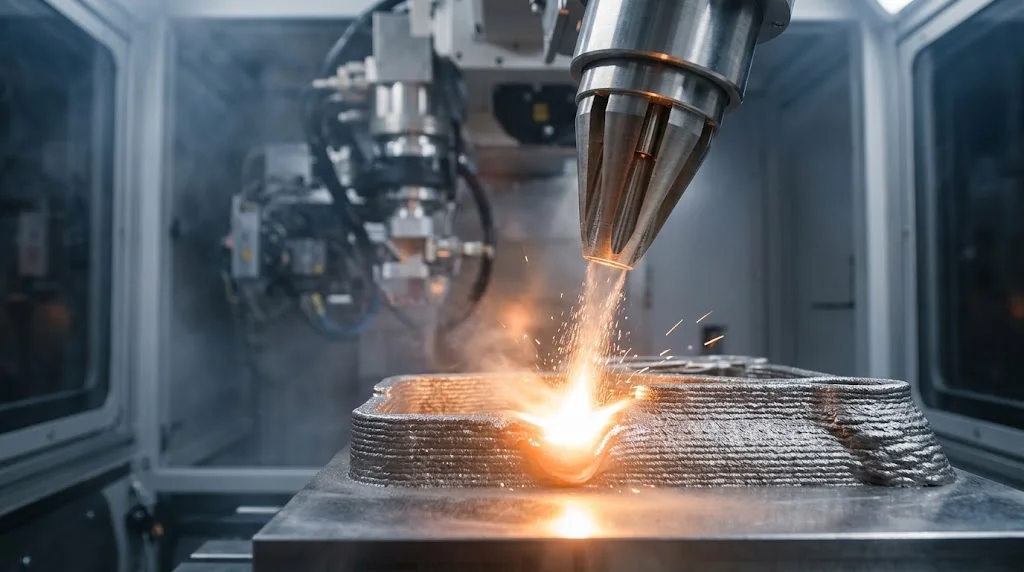
Laser engineered net shaping is a premier direct metal deposition technology. It constructs, enhances, and restores complex metallic parts directly from computer-aided design files. Manufacturing bodies classify this process under Directed Energy Deposition. Researchers at Sandia National Laboratories originally developed the technology. Later, Optomec commercialized it for global industrial production. It represents a major leap forward for industrial manufacturing. Consequently, fabricators now add high-performance metal only where the structural design demands it.
During operation, the system directs a high-power laser beam onto a metallic substrate. This focused energy creates a tiny, molten pool of metal. Meanwhile, specialized delivery nozzles inject spherical metal powder directly into this heat zone. The laser moves along preprogrammed toolpaths. Therefore, the melted material solidifies almost instantly into a durable track. By stacking these tracks layer upon layer, the machine builds three-dimensional structures. Furthermore, the finished metal reaches full structural density.
Engineers must understand the distinction between net-shape and near-net shape outcomes. The blown powder process produces a textured exterior profile. Typically, it achieves an accuracy of plus or minus 0.002 inches on the primary plane. As a result, components emerge as near-net shapes. Machine shops then run a swift CNC pass over critical mating faces.
2. Working Mechanics and Real-Time Process Monitoring
The workflow begins with a solid CAD model. Slicing software divides this digital file into flat cross-sections. Next, computer-aided manufacturing software turns these slices into motion paths. Technicians conduct the entire build inside a sealed chamber. They flood this enclosure with high-purity argon gas. This shield prevents oxygen levels from rising above ten parts per million. As a result, reactive alloys remain free of surface oxides.
Thermal control directly dictates mechanical performance. High-power fiber lasers provide the intense energy required to liquefy incoming powder streams. Coaxial nozzles focus the powder spray toward the exact focal point of the beam. Consequently, the stream delivers metal efficiently while maintaining a stable molten zone.
Modern industrial machines rely on closed-loop feedback systems to maintain steady conditions. Process parameter optimization for laser engineered net shaping requires close supervision of laser wattage, movement speed, and powder flow rates. For this reason, builders integrate high-speed optical pyrometers and thermal sensors. These instruments monitor the melt pool continuously. If the melt pool becomes too hot, the computer throttles the laser output immediately. This rapid adjustment prevents keyhole porosity, reduces heat damage, and stabilizes the part.
3. Powder Metallurgy and Compatible Materials
Feedstock quality always influences build strength. Metal powders designed for directed deposition must have smooth, spherical grains. In addition, the particles must flow freely without clumping. Suppliers typically screen the powder to particle sizes between 10 and 53 micrometers. This specific range helps particles melt rapidly inside the laser beam.
Engineers rely on several high-performance alloys across industrial settings:
-
Titanium Alloys: Ti-6Al-4V Grade 5 offers an outstanding strength-to-weight ratio. Furthermore, it complies with ASTM F1472 standards for aerospace and medical implants.
-
Nickel Superalloys: Inconel 718 and Inconel 625 perform well under extreme heat. In fact, they withstand oxidation at temperatures above 650 degrees Celsius.
-
Stainless Steels: 316L provides exceptional resistance to rust and chemical attack. Thus, marine and chemical processing plants use it frequently.
-
Tool Steels: H13 tool steel and 18Ni300 maraging alloys yield very hard surfaces. Tooling shops select them for stamping dies and injection molds.
-
Specialty Alloys: Cobalt-chrome powers orthopedic devices. Similarly, copper-chromium-zirconium suits high-efficiency thermal exchangers.
Furthermore, laser engineered net shaping excels at producing multi-material structures. Operators can feed separate alloys through independent hoppers during a single print run. For instance, the machine can build a ductile steel core and transition to an outer layer of nickel alloy. This gradual change prevents sharp physical boundaries. Therefore, the finished part resists thermal expansion cracking and delamination.
4. Structural Design Considerations and Defect Mitigation
Working with molten metal introduces steep thermal gradients. Rapid heating followed by sudden cooling creates internal residual stresses. If engineers ignore these forces, the finished parts can warp or pull away from the base plate.
Overhang limits represent an important geometric design factor. Unlike powder bed systems, this process does not support overhangs with loose powder. Therefore, downward-facing surfaces steeper than 45 degrees require support columns. Alternatively, operators mount parts onto multi-axis rotary tables. The table tilts the workpiece continuously so the nozzle always works perpendicular to gravity.
Scanning toolpaths also affect internal grain orientation. Running the laser in the same straight lines produces anisotropic properties. In contrast, rotating the laser pattern by 67 or 90 degrees on each layer scatters the thermal stress. Consequently, this cross-hatch approach yields a fine, uniform grain structure with balanced tensile strength.
5. Comparative Analysis: LENS versus Powder Bed Fusion
Engineers regularly compare directed energy systems against powder bed fusion printers like Selective Laser Melting. Both methods serve vital roles across modern facilities.
| Metric | Laser Engineered Net Shaping (DED) | Selective Laser Melting (PBF) |
| Feedstock Delivery | Blown powder stream through nozzles | Flat bed spread with a recoater blade |
| Deposition Speed | Fast (0.2 to 2.5 kilograms per hour) | Slow (0.05 to 0.2 kilograms per hour) |
| Surface Finish (Ra) | As-built Ra between 50 and 200 micrometers | As-built Ra between 5 and 15 micrometers |
| Resolution | Moderate; walls above 0.8 millimeters | High; prints tiny internal cooling channels |
| Base Requirements | Builds on curved, existing metal parts | Requires a flat base plate inside a box |
| Material Flexibility | Blends custom alloys dynamically | Limited to one alloy per build cycle |
| Primary Role | Part restoration, hardfacing, large structures | Small, intricate geometries and brackets |
Powder bed systems excel at tiny interior lattices. However, directed deposition dominates when shops need high build rates and large part repair capabilities.
6. Industrial Applications and Asset Remanufacturing
The primary economic value of this process extends beyond new fabrications. In practice, its most profitable role involves repairing worn industrial components. Aerospace maintenance facilities frequently handle turbine blades with localized damage. Traditionally, airlines had to scrap these expensive components.
Today, laser scanners map the damaged area with high precision. Next, a mill clears away the worn surface. Finally, the laser engineered net shaping system deposits fresh superalloy directly onto the worn zone. The new deposit forms a clean metallurgical bond with the parent metal. Consequently, this repair technique restores turbine seals and compressor parts at a fraction of replacement costs.
The medical industry also adopts this process for custom joint implants. Surgeons require porous textures on artificial hips and knees to promote bone adhesion. By varying laser energy settings, operators create controlled surface pores while keeping the inner core solid.
Heavy manufacturing plants use this technology for protective surface cladding. Technicians coat drilling tools, pump impellers, and valves with tungsten carbide or cobalt alloys. As a result, these components withstand corrosive liquids and abrasive wear far longer.
7. Hybrid Additive Manufacturing and CNC Post-Processing
The textured surface finish of blown powder parts drove the rise of hybrid systems. Hybrid machines combine metal deposition heads and five-axis milling tools inside one frame. This setup solves the near-net shape challenge immediately.
The additive head deposits raw metal close to the final dimensions. Afterward, the milling tool machines critical mounting holes and smooth sealing surfaces. Because the part remains on the original fixture, alignment errors disappear. Moreover, the cutter can smooth internal cavities before subsequent printed layers seal them.
Most printed parts also require thermal conditioning. Technicians place fresh parts into vacuum ovens for stress-relief annealing. This step relaxes locked-in thermal strain. In addition, critical aerospace components undergo Hot Isostatic Pressing. High heat and intense gas pressure squeeze out micro-voids. Consequently, parts achieve full fatigue resistance under heavy operational cycles.
8. Economic Impact, Buy-to-Fly Ratios, and Sustainability
Raw material waste represents a serious challenge in aerospace production. Traditional CNC machining of aircraft bulkheads generates buy-to-fly ratios of 10 to 1. That means companies turn ninety percent of an expensive titanium block into metal shavings.
Near-net shape deposition lowers that ratio down to roughly 1.2 to 1. The laser engineered net shaping technique uses only the metal necessary for the final profile. Thus, companies save expensive alloy and shorten machine run times. Furthermore, recycling systems catch unused powder from the chamber. Technicians sieve and clean this excess powder for future jobs.
Repairing existing hardware also brings substantial environmental benefits. Rebuilding a massive shaft saves significant energy compared to casting and forging a brand-new component. Therefore, factories reduce supply chain lead times and lower their total carbon footprint.
9. Regulatory Standards and Aerospace Qualification
Deploying additive systems in aviation requires strict compliance with international manufacturing codes. Industry organizations establish strict benchmarks for raw powder, machine checks, and testing.
Aviation authorities reference AMS 5662 for Inconel parts and ASTM F1472 for titanium medical hardware. Furthermore, ISO/ASTM 52900 governs general additive terminology. Suppliers must track every powder batch back to certified smelting sources. They verify gas purity and ensure low levels of hydrogen and oxygen.
To secure flight certification, repair stations must prove that laser engineered net shaping repairs match original manufacturer strength targets. Technicians cut test tabs from each run and conduct tensile and impact testing. These laboratory checks confirm that the deposit remains free of internal pores, microcracks, and bonding flaws.
FAQs
What is the main difference between LENS and standard laser cladding?
Standard laser cladding deposits broad, flat protective coatings across simple plates. In contrast, laser engineered net shaping uses fine laser beams, precision multi-axis paths, and feedback sensors. These tools allow it to construct free-standing three-dimensional shapes and perform intricate repairs.
Can this process deposit material on non-planar surfaces?
Yes, it handles curved parts effortlessly. Powder bed systems require flat plates, but directed powder nozzles can spray from multiple angles. Robotic gantries guide the deposition head along curved pipes, turbine fins, and complex shafts without difficulty.
What are the main limitations of laser engineered net shaping technology?
The main drawbacks include high capital equipment costs and mandatory argon gas consumption. Additionally, as-built surfaces require secondary finish machining to meet tight tolerances. Extremely narrow internal holes also remain difficult to print without hybrid CNC tooling.
How does deposition speed compare to Wire Arc Additive Manufacturing?
Wire Arc Additive Manufacturing deposits metal faster, reaching up to eight kilograms per hour. However, it leaves a very coarse finish and wide heat-affected zones. Laser powder deposition offers superior dimensional accuracy, finer grain structures, and the ability to process crack-sensitive superalloys safely.










Leave a Reply